

Table of Contents
A Greenville home services company publishes a blog post every two weeks. Consistent output, reasonably well-written, professionally formatted. After twelve months, organic traffic has barely moved. The posts don’t rank for anything competitive. The phone isn’t ringing more than it did before the content program started.
This is one of the most common and demoralizing experiences in local content marketing — and it almost always has the same root cause: the content is shallow. Not poorly written, not off-topic, just thin. It covers subjects in 400 words when Google is ranking competitors who cover the same subjects in 1,200. It answers the surface question when searchers are looking for a complete answer. It publishes in isolation when Google rewards interconnected, structured coverage of an entire topic area.
In Greenville’s competitive local markets — legal, healthcare, home services, real estate — content depth isn’t a nice-to-have. It’s the mechanism that separates businesses that rank consistently from businesses that publish consistently without ranking at all. This article explains why shallow content fails, what depth actually looks like in practice, and how Greenville businesses can build the kind of content foundation that earns and holds rankings.
Why Shallow Content Fails in Modern Local Search
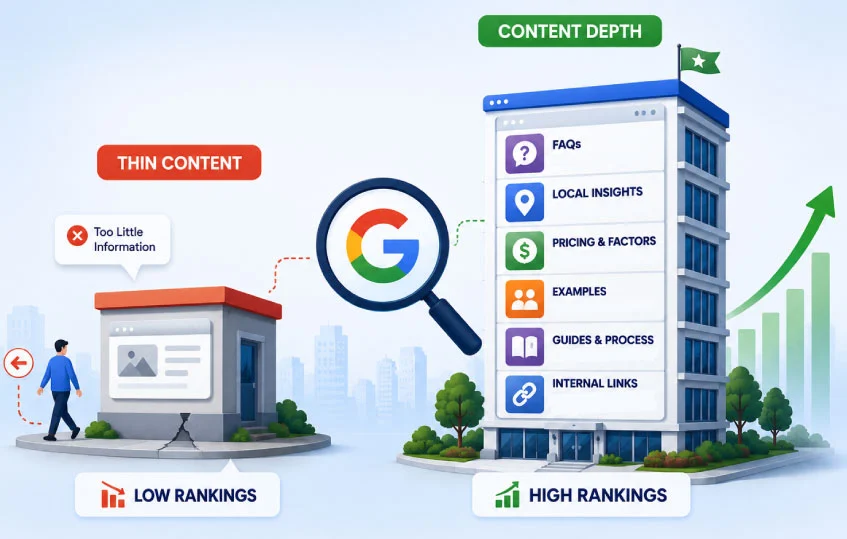
Google’s content quality systems have evolved significantly over the past three years. The Helpful Content updates of 2022 through 2024, and the March 2026 Core Update in particular, formalized a principle that had been building for years: Google rewards content that comprehensively covers a topic, not content that merely addresses a topic.
Shallow content — service pages with a single paragraph, blog posts that skim a subject in under 500 words, FAQ pages with one-sentence answers — fails for three interconnected reasons.
It doesn’t satisfy search intent
When someone searches “roof replacement cost Greenville SC,” they want to understand the factors that affect pricing, typical ranges for Upstate South Carolina, what the process involves, how long it takes, and what to look for in a contractor. A page that answers “costs vary depending on size and materials” and stops there has technically addressed the topic while completely failing the searcher. Google measures this failure through user behavior: visitors who arrive, find insufficient information, and immediately return to search results to find a better answer. That behavioral signal — high bounce rate and low dwell time — tells Google the page isn’t serving the query well, which suppresses rankings over time.
It can’t compete with established authority
When a Greenville law firm publishes a 400-word blog post about personal injury claims, it’s competing against pages from established legal content sites, state bar resources, and competitor firms that have published thorough, well-sourced guides on the same topic. There is no technical optimization that makes a thin page outrank a genuinely comprehensive one targeting the same intent. Depth is the competitive barrier — and without it, content investments produce traffic that never arrives.
It dilutes rather than builds topical authority
A website with 40 shallow blog posts on loosely related topics sends a weaker authority signal than a site with 15 deeply developed, interlinked articles on a tightly defined subject area. According to content cluster research from 2026, a site with 20 interconnected articles on a specific subject will consistently outrank a site with one 5,000-word guide on the same subject — because Google’s quality systems evaluate topical depth across the entire site structure, not just individual page length. Volume without structure and depth doesn’t build authority. It fragments it.
What Content Depth Actually Means — and What It Doesn’t
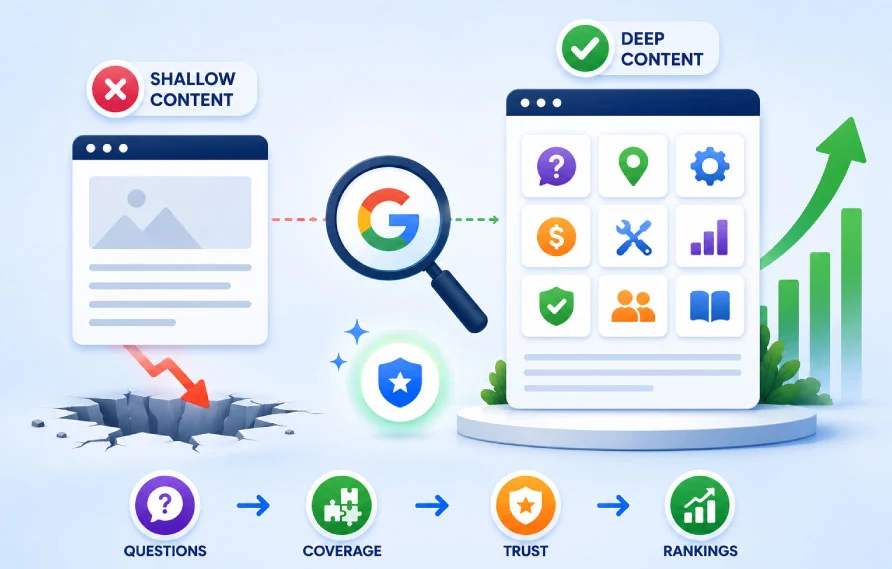
Content depth is frequently misunderstood as word count. It isn’t. A 2,000-word page that repeats the same point five different ways is still shallow content with extra steps. Depth is about completeness of coverage — how thoroughly a piece of content addresses everything a reader genuinely needs to understand a topic or make a decision.
For a Greenville HVAC company writing about heat pump installation, a deep piece of content would cover: what a heat pump is and how it works, why heat pumps are particularly effective for Upstate South Carolina’s climate, the types of heat pump systems available, what the installation process involves and how long it takes, what factors affect cost, how heat pumps compare to traditional HVAC systems on efficiency and long-term operating cost, what questions to ask a contractor before hiring, and what to expect after installation. That’s depth — not because it’s long, but because it answers every question a Greenville homeowner considering a heat pump installation would realistically have.
Intent layering: covering the full decision journey
A single piece of content rarely serves every stage of a buyer’s journey equally well, but the best local content for Greenville businesses layers multiple intent types into a single page. The top of the page addresses the awareness-level question (what is this service?). The middle addresses the consideration-level questions (how does it work, what does it cost, what are the options?). The bottom addresses the decision-level question (why this provider, what’s the next step?). A page structured this way serves first-time researchers and decision-ready buyers simultaneously — and earns rankings across a wider range of queries as a result.
Supporting entities and related concepts
Deep content doesn’t just answer the primary question. It connects the primary topic to related concepts, supporting entities, and adjacent questions that establish a complete picture. A Greenville estate planning attorney writing about wills should naturally reference related concepts: living trusts, power of attorney, healthcare directives, probate court in South Carolina, the differences between state-specific estate laws, and asset protection strategies. This entity-rich content gives Google’s knowledge systems more data points to understand what the page is about and how authoritative it is — and it gives readers more reasons to stay, engage, and convert.
FAQ Integration: Answering the Questions That Drive Rankings and Conversions
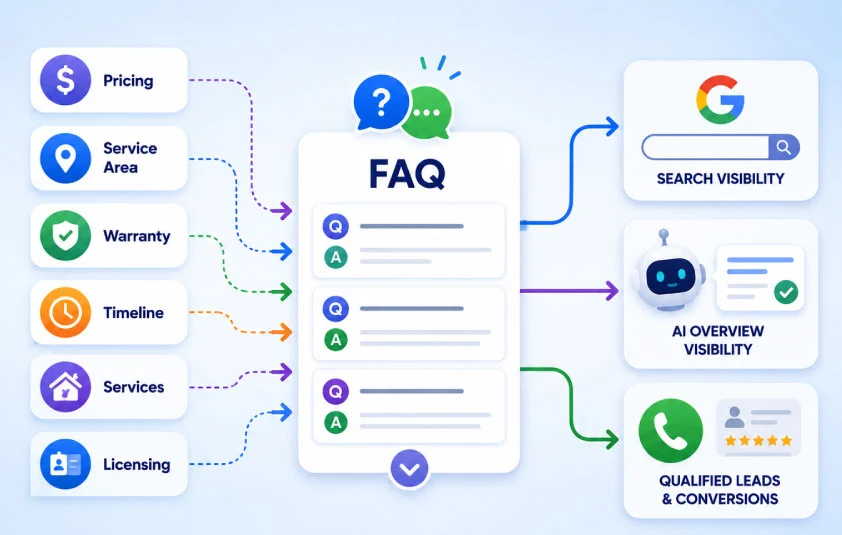
FAQ sections are among the most underutilized content components in Greenville local marketing — and among the most impactful when done correctly.
Every Greenville service business has a set of questions its team answers on every sales call, consultation, or intake form. These are the questions prospective customers are also typing into Google — and often asking AI assistants. A home services company’s staff fields questions about pricing, availability, service area, licensing, timeline, and warranties every day. Those same questions, answered thoroughly on a service page’s FAQ section, serve three purposes simultaneously: they qualify prospective leads before they call, they provide Google with structured question-and-answer content that maps directly to conversational search queries, and they give AI systems clear, citable answers that can surface in AI Overview responses.
FAQ content works best when it’s genuinely informative rather than promotional. “How much does a new roof cost in Greenville, SC?” answered with a real range and the factors that affect it is far more useful — and far more rankable — than “Our pricing is competitive; contact us for a free estimate.” The latter is a non-answer. The former is content depth.
Comprehensive Service Pages: The Highest-ROI Content Investment for Greenville Businesses
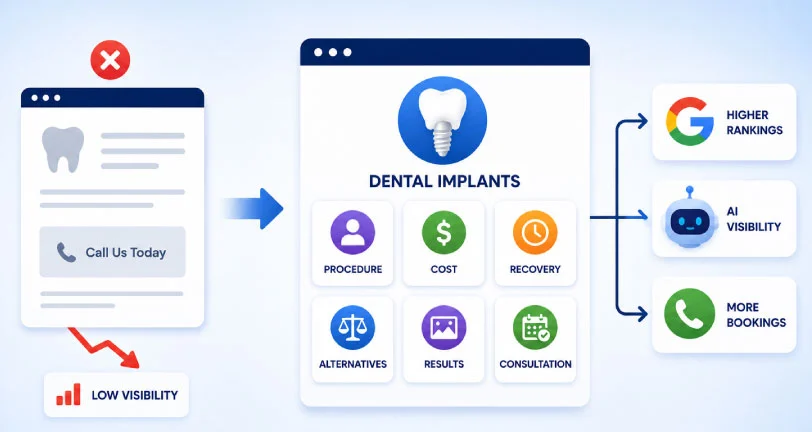
Blog posts build topical authority over time. Service pages close the deal today. For most Greenville businesses, the highest-return content investment is not a blog program — it’s building genuinely comprehensive, intent-matched service pages for each core offering.
A comprehensive service page for a Greenville dental practice’s implant offering should cover: what dental implants are, who is a good candidate, the procedure step by step, recovery and healing timeline, cost factors and typical ranges in the Greenville market, comparison with alternative treatments like bridges or dentures, answers to the most common pre-treatment concerns, before-and-after information, and a clear next step for booking a consultation. That page serves every stage of the patient’s decision process, targets multiple related search queries, and gives Google enough topical coverage to rank it confidently for high-value local searches.
Compare that with a service page that reads: “We offer dental implants in Greenville, SC. Call us today.” Both pages exist. Only one ranks. The depth gap between them is entirely within the practice’s control.
Location-specific content for multi-service-area businesses
Greenville businesses serving the broader Upstate South Carolina market — covering Simpsonville, Mauldin, Taylors, Greer, Spartanburg, or Anderson — need location-specific content that goes beyond swapping a city name into a template. Genuine local depth means referencing specific community context: the neighborhoods, the local infrastructure, the regional climate factors that affect home services, the local legal or regulatory environment relevant to professional services. A roofing contractor’s Simpsonville page should reflect what’s actually different about serving Simpsonville homeowners — housing stock, storm exposure, local code requirements — not just repeat the Greenville page with a different city in the headline.
Building a Content Foundation That Compounds
The businesses winning Greenville local search in competitive industries aren’t publishing more — they’re publishing smarter. The content foundation that compounds over time has three structural layers:
Pillar pages
One authoritative, comprehensive page for each core service or topic area. For a Greenville personal injury law firm: a pillar page on personal injury law in South Carolina. For an HVAC company: a pillar page on HVAC services in Greenville. These pages are the highest-depth, most conversion-focused content on the site — the page a new visitor should land on and find everything they need.
Cluster content
Supporting articles and pages that go deep on specific subtopics within each pillar’s domain. For the personal injury firm: dedicated pages on car accident claims, slip and fall cases, workplace injuries, wrongful death, and the South Carolina statute of limitations. Each page links back to the pillar and cross-links to related cluster pages. For the HVAC company: pages on AC repair, heat pump installation, commercial HVAC, indoor air quality, and seasonal maintenance. The cluster builds topical coverage breadth; the pillar consolidates authority depth.
Supporting blog and FAQ content
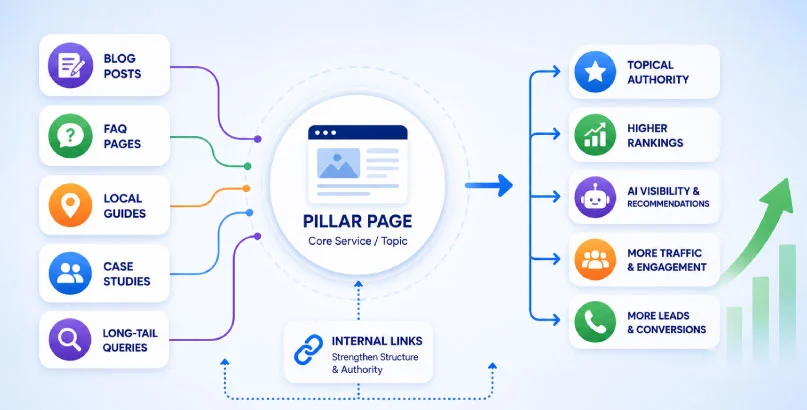
Blog posts and FAQ pages that address the long-tail questions, local context, and decision-stage concerns that service pages don’t have room to cover. These pages feed traffic into the pillar-cluster structure through internal links, capture additional search queries, and build the kind of topical completeness that AI systems reward when surfacing local business recommendations.
The compounding effect emerges from the interaction between these layers. Each new cluster page strengthens the pillar. Each internal link concentrates authority signals. Each answered question expands the range of queries the site ranks for. Businesses that build this structure consistently — even at a modest pace of one or two quality pieces per month — outperform competitors publishing five shallow posts per week within 6 to 9 months.
Frequently Asked Questions
How long should a service page be for a Greenville business to rank competitively?
Word count is a byproduct of depth, not a target in itself. For competitive local searches in Greenville — legal services, healthcare, home services, real estate — service pages that comprehensively cover their topic typically fall between 800 and 1,500 words. Some highly competitive terms require more. The right benchmark is whether the page answers every question a qualified, decision-ready customer would have before contacting you. If it does, the length will follow naturally.
Is blogging still worth it for Greenville local businesses in 2026?
Yes — but only if blog content is strategically connected to your service pages and built for genuine depth. Blogging for its own sake, without a content cluster structure and clear internal linking to conversion pages, produces traffic with no business outcome. Blog content that addresses specific local questions, builds topical coverage around your core services, and links purposefully to your service pages compounds into meaningful authority over time.
How do I know if my current content is too shallow?
Search for your primary service keywords in Greenville and open the top three ranking pages. Compare their depth of coverage — the range of questions they answer, the number of related concepts they address, the specificity of their local context — to your own pages. If your content covers 30% of what they cover, that gap is your ranking problem. A content audit that maps your existing pages against the questions your target customers actually have is the most practical diagnostic.
Can I improve existing content, or do I need to start from scratch?
Improving existing content — adding depth, expanding FAQ sections, strengthening internal links, adding local context — is almost always faster and more effective than starting over. Google already has a crawl history for your existing pages. A meaningful content expansion on an established URL with some authority typically produces ranking movement faster than a brand-new page targeting the same topic. Audit your existing pages before committing to new content creation.
How does content depth affect visibility in AI-generated search answers?
AI systems — including Google’s AI Overviews, ChatGPT, and Perplexity — select content to cite based on demonstrated expertise, factual completeness, and structural clarity. Shallow content is rarely cited because it doesn’t provide the depth of information AI systems need to construct a useful answer. Deep, structured, entity-rich content is far more likely to be surfaced as a reference in AI-generated responses about Greenville businesses and services — which is increasingly how local customers are finding and evaluating providers.
Depth Is the Differentiator — and It’s Entirely Within Your Control
Most Greenville businesses competing in legal, healthcare, home services, and real estate are not losing rankings because of technical problems or lack of backlinks. They’re losing because their content doesn’t go deep enough to earn the trust of Google’s quality systems or satisfy the needs of the customers they’re trying to reach.
The solution isn’t a bigger content budget or a higher publishing frequency. It’s a structural shift: fewer pieces, built to genuinely serve every question a prospective customer has, organized into clusters that build topical authority across an entire subject area, and connected by internal links that concentrate relevance signals on the pages that matter most.
PalmettoSoft builds content strategies for Greenville businesses that are designed to rank, not just to publish. If your current content program isn’t producing leads, we can show you exactly where the depth gaps are and what it would take to close them. Request a free content audit today.