

Table of Contents
A Greenville real estate firm has been paying for SEO for 18 months. The agency sends monthly reports. Keywords are moving. Traffic is up slightly. But the phone isn’t ringing more than it did before, and the principal can’t point to a single closed deal that came from organic search.
This scenario is more common than any SEO company will readily admit. The problem isn’t always that SEO doesn’t work — it’s that it’s being done wrong, measured wrong, or both. For Greenville businesses in competitive industries like medical, legal, real estate, and contracting, SEO errors don’t just mean missing page-one rankings. They translate directly into revenue that goes to competitors, month after month.
Here are the SEO mistakes most commonly costing Greenville businesses thousands — and what a smarter approach looks like.
Mistake #1: Treating SEO as a Traffic Metric Instead of a Revenue Driver
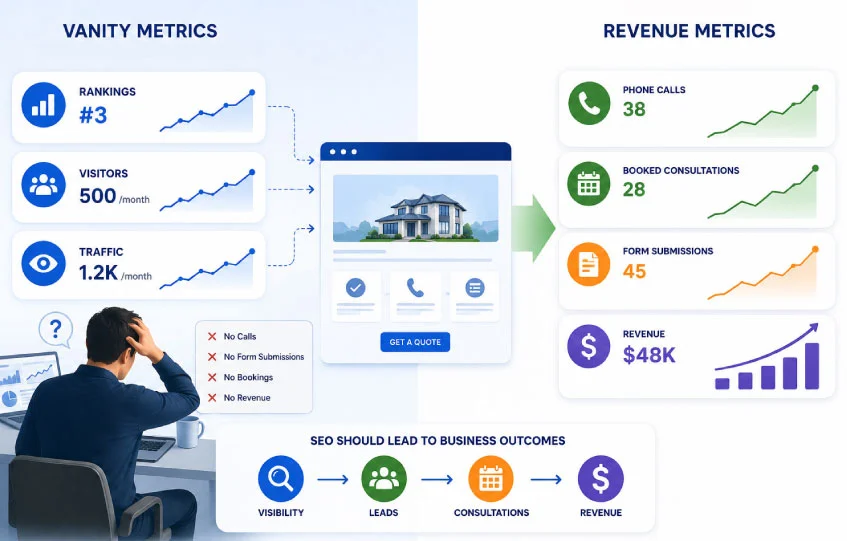
The most expensive mindset in local SEO isn’t a technical error — it’s strategic. Business owners who measure SEO success by keyword rankings and session counts are measuring the wrong things.
Rankings and traffic are leading indicators. Revenue is the goal. A Greenville medical practice ranking for “primary care physician” but receiving no new patient inquiries has a conversion problem, not a ranking victory. A contractor driving 500 monthly visitors to a service page with no clear call to action has traffic it can’t monetize.
Every SEO engagement should be anchored to revenue-connected KPIs: form submissions, phone calls, booked consultations, and qualified lead volume. Keyword rankings tell you where you are on the board. Revenue metrics tell you whether you’re actually winning.
Mistake #2: Poor Site Structure That Dilutes Authority
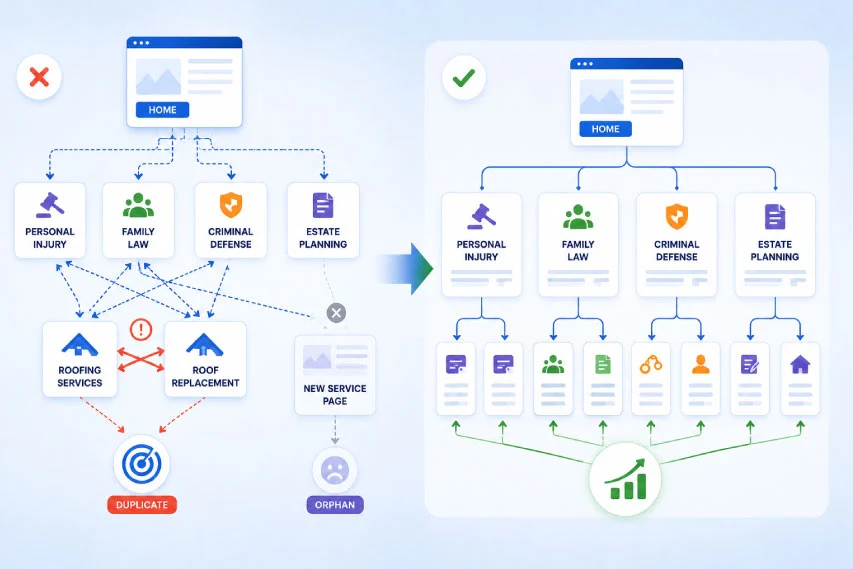
Site architecture is one of the most overlooked SEO variables for Greenville small businesses — and one of the most consequential. When a website doesn’t have a clear logical hierarchy, authority signals get scattered instead of concentrated.
The “everything on one page” trap
A Greenville law firm that covers personal injury, family law, criminal defense, and estate planning on a single “Practice Areas” page is competing for every one of those terms with a single page — against competitors with dedicated, content-rich pages for each. Google rewards specificity. One strong page per distinct topic almost always outperforms an overview page trying to do everything.
Keyword cannibalization
When multiple pages on the same website target the same keyword, they compete against each other in search results. This is especially common on contractor websites that create both a “Roofing Services” page and a “Roof Replacement” page with overlapping content. Google struggles to determine which page to rank, and often promotes neither. A proper site structure assigns clear keyword ownership to each page.
Orphaned pages
Pages that receive no internal links from other site pages are effectively invisible to search engines. A new service page that was published but never linked to from the site navigation, blog posts, or related pages accumulates no authority and rarely ranks. Every valuable page on a Greenville business website should be connected to the broader site architecture.
Mistake #3: A Content Strategy That Ignores Search Intent
Publishing content without matching it to what potential customers actually search for is a widespread and expensive mistake. Content that doesn’t align with search intent doesn’t rank, and content that ranks but mismatches intent doesn’t convert.
Search intent has four categories: informational (someone learning about a topic), navigational (someone looking for a specific site), commercial (someone comparing options), and transactional (someone ready to take action). Most Greenville business websites need transactional and commercial-intent pages as their core — but often invest primarily in generic informational content.
A Greenville dental clinic that publishes blog posts about general dental health tips may accumulate some informational traffic, but it’s the “cosmetic dentist Greenville SC” and “dental implants Greenville” service pages — built for commercial and transactional intent — that drive consultations. Without those intent-matched pages, the blog traffic produces engagement with no conversion pathway.
Mistake #4: Targeting the Wrong Geographic Keywords
Local SEO depends on geographic specificity, and many Greenville businesses either target too broadly or too narrowly.
Competing for a keyword like “real estate agent” against national aggregators and regional chains is a losing proposition for an independent Greenville firm. The same business has a clear path to visibility with “real estate agent Greenville SC,” “homes for sale in Five Forks,” or “Greenville SC relocation specialist.” Geo-modified keywords carry lower competition and higher local purchase intent.
The inverse mistake is hyper-localizing every page to a single neighborhood when the business actually serves the broader Greenville metro area — including Simpsonville, Mauldin, Taylors, and Greer. A service company that only optimizes for the city of Greenville is invisible to searches happening in its surrounding service footprint.
Geographic targeting should reflect actual service area, realistic competitive positioning, and the specific language local customers use when searching.
Mistake #5: Neglecting Technical SEO Until It Becomes a Crisis

Technical SEO problems are the silent revenue killers. They rarely announce themselves with obvious symptoms — traffic usually declines gradually, rankings erode slowly, and business owners often attribute the decline to market conditions rather than website problems.
Schema markup gaps
Local business schema, service schema, and review schema help Google understand exactly what your business offers, where it’s located, and how customers rate it. Without structured data markup, Google has to infer this information from page content — and sometimes infers incorrectly. For Greenville businesses, properly implemented LocalBusiness schema with accurate NAP data, service areas, and operating hours is a straightforward technical win that many competitors still haven’t implemented.
Core Web Vitals failures
Google’s page experience signals — Largest Contentful Paint, Interaction to Next Paint, and Cumulative Layout Shift — are ranking factors. A Greenville contractor’s website that scores poorly on mobile page speed is being penalized relative to competitors with faster sites, regardless of content quality. Most Core Web Vitals failures stem from unoptimized images, render-blocking scripts, and low-quality hosting.
HTTPS and security issues
Websites without valid SSL certificates display browser warnings that destroy visitor trust before they read a single word. These sites also receive a ranking penalty from Google. In 2026, there is no legitimate reason for a Greenville business website to be running on HTTP.
Mistake #6: Ignoring Local Link Authority
Backlinks — links from other websites to yours — remain one of the strongest ranking signals in Google’s algorithm. For local search specifically, links from geographically relevant sources carry disproportionate weight.
Greenville businesses that neglect link building often see their rankings plateau even after strong on-page and technical work. Meanwhile, a competitor earning links from the Greenville Chamber of Commerce, the Upstate Business Journal, local news coverage from WYFF or Greenville Online, and sponsorship pages for community events is building local authority that’s very difficult to overcome with content alone.
Effective local link building doesn’t require an aggressive outreach campaign. Sponsoring Greenville-area events, joining local business associations, earning press mentions through newsworthy business activity, and partnering with complementary local businesses for cross-referral content all generate the kind of relevant, trustworthy backlinks that improve local search performance.
Mistake #7: Measuring Results Too Soon and Abandoning Strategy Too Early
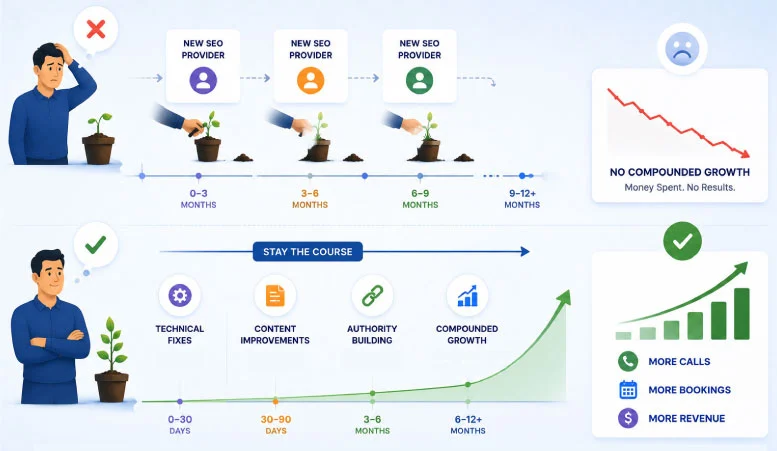
SEO is a compounding investment, and the timeline mismatch between business owner expectations and search engine reality is responsible for enormous wasted spend in the Greenville market.
Technical fixes can produce movement within weeks. Content improvements typically show ranking changes within 60 to 90 days. Building domain authority through link acquisition and sustained content production is a 4 to 8 month process before results become consistent. Businesses that evaluate SEO performance at the 90-day mark and conclude it isn’t working are often cutting off a strategy that was on the verge of delivering.
The more damaging pattern is cycling through SEO providers. A Greenville business that switches agencies every 4 to 6 months because results haven’t materialized spends months of each engagement having the new provider undo the previous provider’s work. The business pays repeatedly and accumulates nothing. A clear performance benchmark, agreed upon at the start of an engagement and tied to revenue-connected metrics rather than rankings alone, is the solution.
Frequently Asked Questions
How do I know if my SEO company is actually delivering results?
Ask them to connect their deliverables directly to lead and revenue metrics, not just rankings. A legitimate Greenville SEO company should be able to show you which organic landing pages are generating form submissions or phone calls, and what the trend looks like over 3 to 6 months. If the only reporting you receive covers keyword positions, that’s a signal the relationship is focused on the wrong outcomes.
What’s the difference between cheap SEO and professional SEO for Greenville businesses?
Low-cost SEO services typically produce activity without strategy: generic blog posts, automated directory submissions, and keyword stuffing that temporarily moves rankings before triggering penalties. Professional Greenville SEO starts with an audit, builds a site architecture and content plan tied to real search demand, executes technical corrections, and connects all of it to conversion outcomes. The difference in cost is real — and so is the difference in results over 12 to 24 months.
Can SEO mistakes actually get my Greenville website penalized?
Yes. Keyword stuffing, thin or duplicate content, manipulative link schemes, and cloaking can all result in manual or algorithmic penalties that suppress rankings significantly. Google’s Spam Policies are enforced both manually by Google’s review team and automatically through core algorithm updates. Recovery from a penalty typically takes months and requires demonstrating that the problematic practices have been fully corrected.
Is paid search a substitute for fixing SEO mistakes?
No, but it’s a useful complement while SEO improvements take effect. Google Ads can generate leads immediately for Greenville businesses while organic rankings are being built. But paid search stops the moment the budget stops. SEO builds an asset — organic ranking positions — that continues generating traffic and leads without ongoing ad spend. The two strategies work best in parallel, not as substitutes for each other.
How much should a Greenville business expect to invest in professional SEO?
Meaningful local SEO for competitive Greenville industries — legal, medical, real estate, home services — typically requires a sustained monthly investment in the range of $1,000 to $3,000 depending on competitive density and the scope of work. Engagements priced significantly below that range rarely include the technical depth, content production, and link development needed to move rankings in competitive markets.
SEO Should Be a Revenue Engine, Not a Reporting Exercise
Every one of these mistakes has something in common: it separates SEO activity from business outcomes. The Greenville businesses winning at organic search have aligned their SEO investments with specific revenue goals, built site structures that serve both users and search engines, matched their content to real search intent, and given their strategies enough time to compound.
The ones paying for SEO without seeing results are usually making several of these mistakes simultaneously — and often don’t know it because their reporting focuses on vanity metrics instead of leads.
PalmettoSoft works with Greenville businesses to identify exactly where their SEO investment is leaking and build strategies that connect search visibility to revenue. If your current SEO isn’t producing leads, request a free audit and find out why.