

Table of Contents
Two Greenville law firms. Similar practice areas, comparable websites, similar review counts. One appears consistently in the top three local results and inside AI-generated search summaries. The other ranks on page two and rarely surfaces in AI Overviews. The gap between them isn’t budget — it’s how Google understands each website’s depth of expertise.
That difference comes down to semantic SEO — and most Greenville businesses competing in healthcare, legal, real estate, and multi-location services have barely begun to leverage it.
This article explains what semantic SEO is, why it’s replacing keyword-focused optimization as the primary driver of local search rankings, and how Greenville businesses can build the kind of topical authority that outperforms competitors in both traditional search results and the AI-driven experiences that now shape how customers find local providers.
What Is Semantic SEO — and Why Does It Matter for Greenville Businesses?
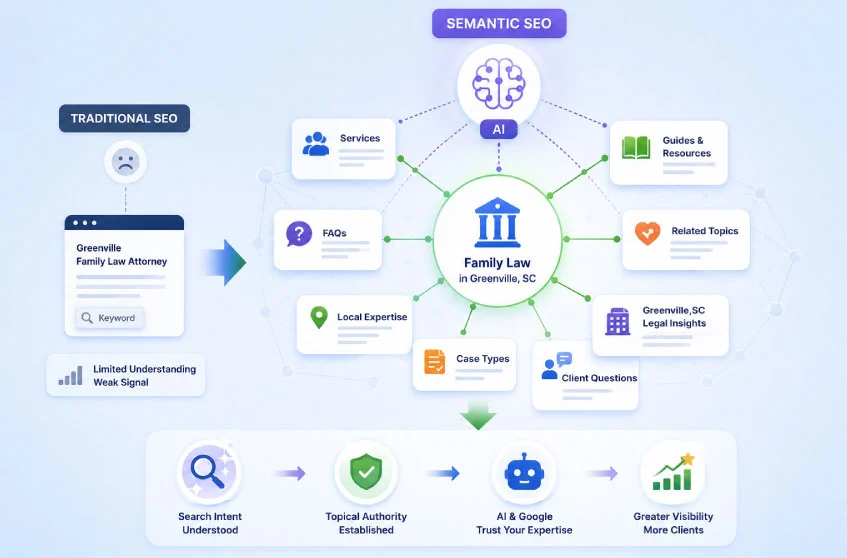
Traditional keyword SEO was built around a simple idea: include the phrases people search for on the pages you want to rank. Google matched keywords in queries to keywords on pages. That model worked for years.
Semantic SEO operates on a different principle entirely. Rather than matching strings of text, modern search engines — powered by natural language processing and entity-based knowledge systems — evaluate meaning, context, and relationships between ideas. Google doesn’t just want to know that your page mentions “Greenville family law attorney.” It wants to understand whether your site is a comprehensive, trustworthy source on the topic of family law in Greenville, SC.
For competitive local markets, this distinction is decisive. A Greenville healthcare practice that has built genuine topical depth around its specialty — with interconnected content covering related conditions, treatments, patient questions, and local care context — signals expertise that a site with three generic service pages cannot match, regardless of how well those pages are keyword-optimized.
Semantic SEO is also the foundation of visibility in AI-generated search experiences. When Google’s AI Overviews or ChatGPT synthesize an answer about Greenville service providers, they draw from sources that have demonstrated structured, trustworthy expertise on the topic — not sources that simply repeat a keyword most frequently.
Topical Authority: The Concept Reshaping Local SEO Strategy
Topical authority is the degree to which Google recognizes your website as a comprehensive, reliable source on a specific subject area. It’s built through breadth and depth of coverage — not any single page.
Think of it this way: a Greenville orthopedic clinic that publishes a single page titled “Orthopedic Services” has one data point for Google to evaluate. A competitor that has published thorough, interlinked content covering sports injuries, joint replacement, post-surgical rehabilitation, injury prevention for Upstate SC athletes, and specific conditions like rotator cuff tears and ACL reconstruction has given Google dozens of signals that this site is a genuine authority on orthopedic care.
When a patient searches “orthopedic surgeon Greenville SC,” Google is choosing between those two footprints. The second site wins — not because it keyword-optimized harder, but because it built a web of relevant, interconnected content that establishes expertise across the entire topic space.
Content clusters and pillar pages
The structural model for building topical authority is the content cluster: a central pillar page covering a broad topic comprehensively, surrounded by cluster pages that go deep on specific subtopics, all internally linked to one another.
For a Greenville HVAC company, the pillar page might be a comprehensive guide to HVAC services in Greenville, SC. The cluster pages dig into specific topics: AC repair vs. replacement, heat pump selection for Upstate SC climate, air quality concerns in older Greenville homes, seasonal maintenance checklists, and energy efficiency upgrades available through South Carolina utility programs. Each cluster page links back to the pillar, and the pillar links out to each cluster. Google reads this architecture as a cohesive body of expertise — not a collection of isolated pages.
Entity Relevance: How Google Identifies What Your Business Is Really About
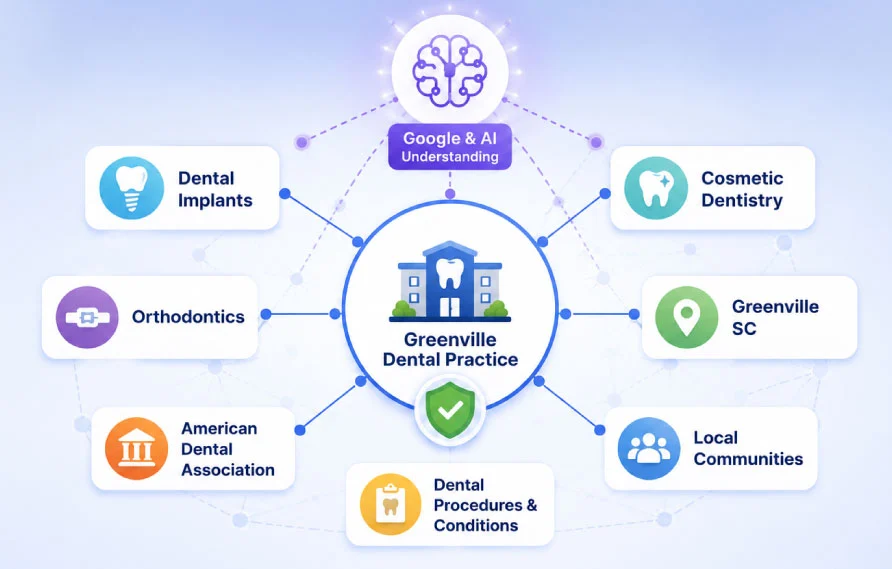
In Google’s current search model, the web is understood as a network of entities — people, places, organizations, concepts, and things — and the relationships between them. Your business is an entity. So are your services, your location, your industry associations, and your competitors.
Entity relevance is the degree to which Google’s knowledge systems associate your website with the right entities for your market. For a Greenville dental practice, relevant entities include: cosmetic dentistry, dental implants, orthodontics, Greenville SC, Upstate South Carolina, the American Dental Association, specific dental conditions and procedures, and the neighborhoods and communities your practice serves.
When your website content, Google Business Profile, citations, and structured data consistently reinforce the same entity relationships, Google builds confidence in what your business is and who it serves. That confidence translates into ranking positions and inclusion in AI-generated answers.
Schema markup as entity communication
Structured data markup — specifically LocalBusiness, MedicalOrganization, LegalService, and related schema types — is the most direct way to communicate entity information to search engines. Schema tells Google not just that you mention certain words, but that your business is a specific type of entity, located at a specific address, offering specific services to a specific geographic area.
For a Greenville multi-location business — a law firm with offices in Greenville and Spartanburg, or a medical practice with clinics in Greenville, Simpsonville, and Mauldin — correctly implemented schema for each location, with accurate service-area markup and appropriate entity relationships, is a significant competitive differentiator that most local competitors haven’t implemented.
Intent Matching: Writing for How Greenville Customers Actually Think
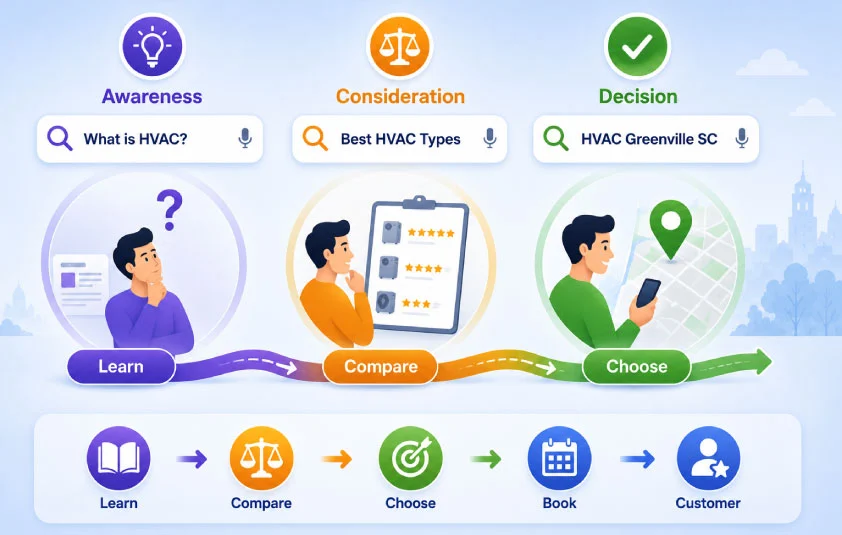
Search intent is the underlying goal behind a query. Semantic SEO requires content that satisfies intent — not just content that includes the right keywords.
A Greenville real estate agent’s blog post titled “5 Things to Know About Buying a Home” has weak intent alignment. It competes with national content from Zillow, Redfin, and the National Association of Realtors. Compare it with “What to Expect When Buying a Home in the Augusta Road Area of Greenville, SC” — a page that addresses the specific, local intent of a buyer who already knows they want to live in that neighborhood. The second page has almost no national competition and directly serves someone who is close to making a decision.
Intent matching at a local level means creating content that answers the questions Greenville customers ask at every stage of the buying journey: awareness (“what is a commercial HVAC system?”), consideration (“HVAC system types for commercial buildings in South Carolina”), and decision (“commercial HVAC installation Greenville SC”). Each stage requires different content, and together they build the topical coverage that signals authority.
Semantic SEO and AI-Driven Search: The 2026 Competitive Reality
AI has fundamentally changed how search results are presented. Google’s AI Overviews synthesize answers from multiple sources at the top of results pages. ChatGPT and other AI tools are increasingly used by consumers to find local service providers. Voice search queries via assistants like Siri and Google Assistant demand direct, structured answers.
All of these AI systems share a preference for the same type of content: structured, comprehensive, factually clear, and authoritative. A Greenville business that has built genuine topical authority through semantic SEO is far more likely to be cited as a source in AI-generated answers than a competitor with a keyword-stuffed website and thin content.
This matters practically. A potential patient asking ChatGPT “who are the best orthopedic surgeons in Greenville SC” is not browsing ten blue links. They’re receiving a synthesized recommendation. The practices most likely to appear in that answer are those whose websites have given AI systems the strongest signals of expertise, relevance, and local authority — which is exactly what semantic SEO builds.
How Greenville Businesses Can Start Building Semantic SEO Authority
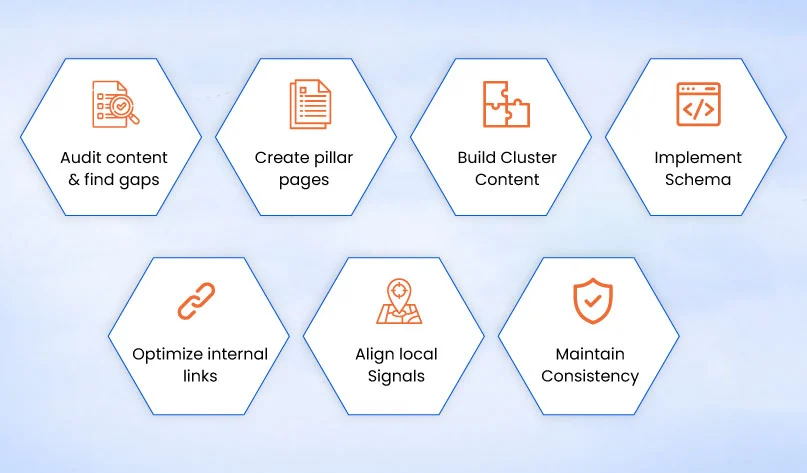
Building topical authority is a systematic process, not a single campaign. Here’s where to start:
- Audit existing content for gaps — identify the topic areas your target customers research and map them against your current content. The gaps are your opportunity.
- Build or restructure service pages as pillar content — each core service should have a thorough, dedicated page that serves as the authoritative entry point for that topic on your site.
- Develop cluster content around each pillar — supporting articles, FAQs, local guides, and case studies that go deep on specific subtopics within your service area.
- Implement structured data markup — LocalBusiness schema, service schema, and FAQ schema at minimum; specialized schema (MedicalOrganization, LegalService, HomeAndConstructionBusiness) where applicable.
- Optimize internal linking — every cluster page should link to its pillar, and the pillar should link to all relevant cluster pages. Related cluster pages should cross-link where content is genuinely connected.
- Align content with local entity signals — consistently reference Greenville-specific context, neighborhoods, regional landmarks, and local organizations that reinforce your geographic relevance.
- Maintain topical consistency across GBP and citations — the entities your website establishes should be reinforced in your Google Business Profile service descriptions, posts, and category selections.
The competitive advantage of semantic SEO is that it compounds. Each piece of content you add strengthens the authority of existing content. Each internal link you build concentrates relevance signals. Competitors who continue optimizing individual pages for individual keywords will find it increasingly difficult to outrank a Greenville business that has built a structured, entity-rich content ecosystem.
Frequently Asked Questions
Is semantic SEO relevant for small Greenville businesses, or just large companies?
Semantic SEO is especially valuable for small and mid-size Greenville businesses because it’s an equalizer. A local roofing contractor can build stronger topical authority on “roof replacement in Greenville SC” than a national chain that covers the same topic generically across hundreds of markets. Geographic specificity and genuine local expertise are semantic signals that national competitors can’t replicate.
How is semantic SEO different from what my current SEO company is already doing?
Most traditional SEO focuses on optimizing individual pages for individual keywords — targeting a phrase, building a page, acquiring links to that page. Semantic SEO starts at the topic level: mapping an entire subject area, building structured content coverage, and creating the entity relationships that establish authority across a domain. If your current strategy is page-by-page rather than topic-by-topic, it’s likely leaving substantial ranking potential on the table.
How long does it take to build topical authority in a competitive Greenville market?
For competitive industries like legal, healthcare, and real estate in Greenville, meaningful topical authority typically develops over 4 to 9 months of consistent content development and technical optimization. Simpler markets or less competitive niches can see results faster. The timeline depends on competitive density, the volume and quality of content produced, and the technical foundation supporting it.
Does semantic SEO help with appearing in AI Overviews and ChatGPT answers?
Yes — it’s the primary mechanism. AI systems select sources based on demonstrated expertise, structured content, clear entity relationships, and factual accuracy. Websites with strong topical authority are more likely to be cited in AI-generated answers than sites optimized purely for keyword density. Building semantic SEO is also building the foundation for AI search visibility.
What is a content cluster and how many does my Greenville business need?
A content cluster is a pillar page covering a broad topic, supported by a set of related, internally linked pages going deeper on specific subtopics. A Greenville law firm might build clusters around personal injury, family law, criminal defense, and estate planning — each with its own pillar and supporting content. How many clusters you need depends on your service range and competitive landscape. Starting with one well-developed cluster for your highest-revenue service area and expanding from there is a practical approach.
Semantic SEO Is How Greenville Businesses Win the Long Game
Keyword optimization gets you on the board. Semantic SEO is what keeps you ahead of competitors who are also on the board.
For Greenville businesses in competitive industries, the shift to entity-based, topically authoritative content isn’t optional — it’s the path to sustainable local search visibility in an environment where AI is reshaping how customers find and choose service providers. The businesses investing in this approach now are building a compounding asset that becomes harder to displace over time.
PalmettoSoft helps Greenville businesses build the topical authority and semantic content infrastructure that drives rankings in both traditional and AI-driven search. If you’re ready to move beyond keyword optimization and build a local SEO strategy that compounds, let’s talk.