

Table of Contents
Remodeling companies in Myrtle Beach face a structural SEO challenge: they offer many services, but their websites often blend those services together. Kitchen remodeling, bathroom renovations, home additions, whole‑home remodeling — each one has different search intent, different customer psychology, and different keyword patterns.
When these services live on a single “Remodeling Services” page, they compete against each other. Google doesn’t know which page should rank for which query. Customers don’t know where to click. And the company loses visibility across the entire Grand Strand.
A well‑structured SEO strategy solves this problem. By creating dedicated, keyword‑focused service pages and organizing them with a clear hierarchy, remodeling companies can rank each service independently, attract higher‑intent leads, and build long‑term authority in Myrtle Beach, North Myrtle Beach, Surfside Beach, Conway, and the surrounding coastal communities.
This article breaks down the exact steps remodeling companies can take to optimize multiple service pages without cannibalizing rankings — and how to turn their website into a high‑intent lead engine.
Why Remodeling SEO Is More Complex Than Other Home Services
Remodeling is not a single service. It’s a cluster of services, each with its own intent patterns.
Kitchen remodeling intent
Customers search for:
- kitchen remodel Myrtle Beach
- kitchen renovation cost
- kitchen cabinet upgrades
- open‑concept kitchen design
- kitchen layout changes
These searches are high‑value and often involve long decision cycles.
Bathroom remodeling intent
Searches include:
- bathroom remodel Myrtle Beach
- walk‑in shower installation
- tile replacement
- bathroom renovation cost
These customers often want clarity on materials, timelines, and pricing.
Home additions intent
Searches include:
- home addition Myrtle Beach
- room addition cost
- second‑story addition
- garage conversion
These projects require trust, permitting knowledge, and structural expertise.
Whole‑home remodeling intent
Searches include:
- whole‑home remodel
- full renovation Myrtle Beach
- coastal home renovation
These customers want a partner who can manage complexity.
Each intent pattern deserves its own page. When everything is combined, Google cannot match the right page to the right search.
Create Dedicated, Keyword‑Focused Service Pages
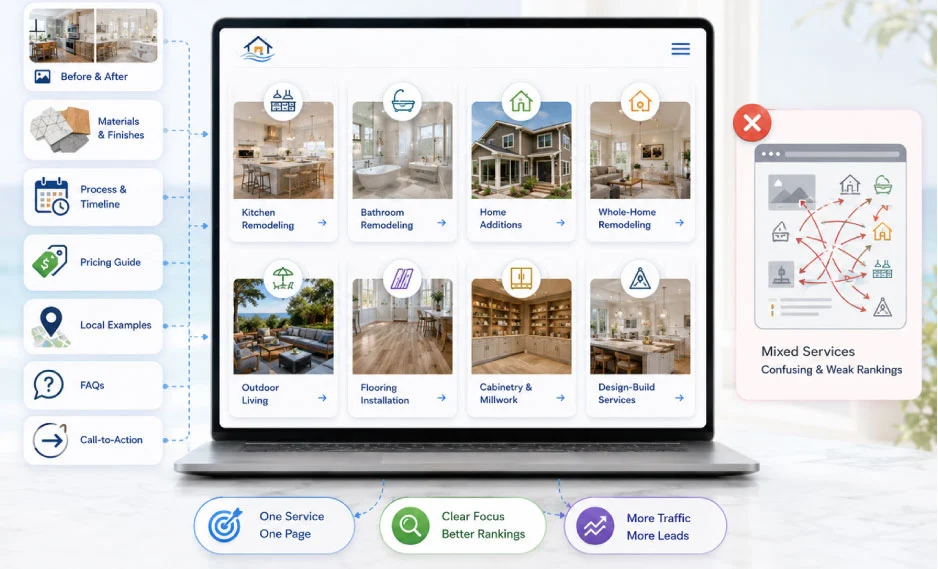
The foundation of remodeling SEO is simple: one service = one page.
Minimum page structure
Your website should include:
- Kitchen Remodeling
- Bathroom Remodeling
- Home Additions
- Whole‑Home Remodeling
- Outdoor Living Spaces
- Flooring Installation
- Cabinetry & Millwork
- Design‑Build Services
Each page should be built around a single keyword cluster.
What each service page must include
To rank and convert, each page needs:
- A clear definition of the service
- Before/after photos
- Material options (tile, flooring, cabinetry, countertops)
- Timeline expectations
- Pricing signals (ranges, factors, cost drivers)
- Local examples (Market Common, Carolina Forest, Grande Dunes)
- FAQs
- A clear call‑to‑action
Avoid blending services
Do not combine:
- kitchen + bathroom
- additions + whole‑home
- flooring + cabinetry
Blended pages confuse Google and dilute keyword relevance.
Organize Your Website with a Clear Hierarchy
A remodeling website should function like a well‑structured home: every room has a purpose, and everything connects logically.
Recommended hierarchy
Home
→ Remodeling Services (hub page)
→ Kitchen Remodeling
→ Bathroom Remodeling
→ Home Additions
→ Whole‑Home Remodeling
→ Outdoor Living Spaces
→ Flooring Installation
→ Cabinetry & Millwork
Why this hierarchy matters
- Google understands which page is the parent and which is the child
- Each service page ranks independently
- Internal linking becomes predictable
- Cannibalization disappears
- AI systems can map your topical authority
This structure also improves user experience — customers can navigate intuitively.
Strengthen Internal Linking to Support Each Service Page
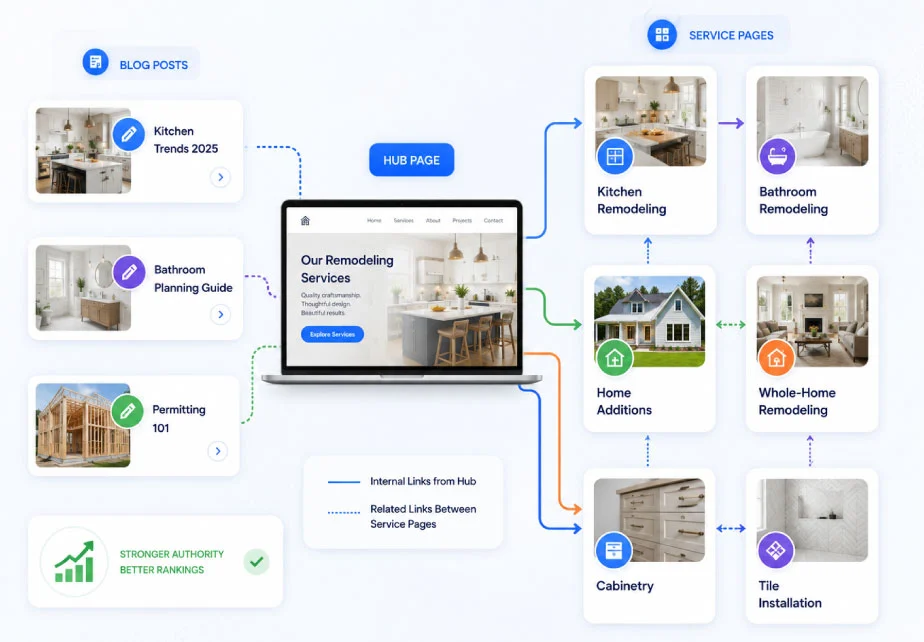
Internal linking is one of the most overlooked remodeling SEO tactics.
Link from the hub page to each service page
This signals to Google:
- “These are our core services.”
- “Each service deserves its own ranking.”
Link between related service pages
Examples:
- Kitchen → Cabinetry
- Bathroom → Tile Installation
- Home Additions → Whole‑Home Remodeling
This builds topical clusters.
Link from blog posts to service pages
Examples:
- “Top Kitchen Trends in Myrtle Beach” → Kitchen Remodeling
- “How to Plan a Bathroom Renovation” → Bathroom Remodeling
- “Permitting Requirements for Home Additions” → Home Additions
This strengthens authority and improves rankings.
Use Myrtle Beach‑Specific and Grand Strand Location Pages
Remodeling companies often serve multiple areas but fail to create content for each location. This limits visibility.
City‑specific pages
Create pages for:
- Myrtle Beach
- North Myrtle Beach
- Surfside Beach
- Conway
- Murrells Inlet
- Carolina Forest
Each page should include:
- local architectural styles
- common remodeling challenges (humidity, salt air, aging coastal homes)
- neighborhood examples
- local testimonials
Neighborhood‑specific pages
High‑intent neighborhoods include:
- Market Common
- Grande Dunes
- Carolina Forest
- Cherry Grove
- Socastee
These pages rank for hyper‑local searches and convert at a higher rate.
Optimize Project Galleries for Remodeling SEO
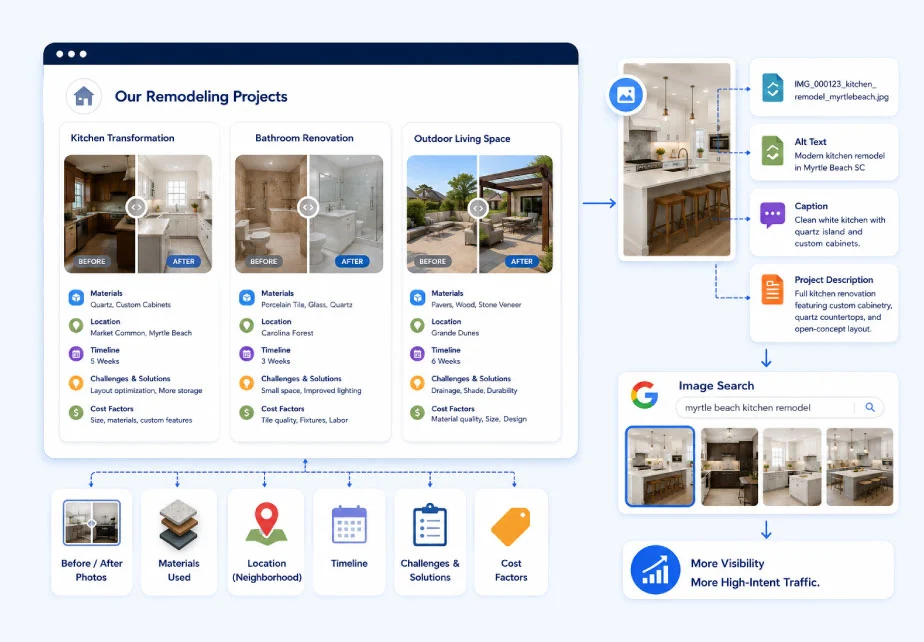
Remodeling is visual. Customers want proof of craftsmanship.
Each project should include
- Before/after photos
- Materials used
- Location (neighborhood or city)
- Timeline
- Challenges and solutions
- Cost factors (not exact pricing)
Optimize for Google Image Search
Use:
- descriptive file names
- alt text
- captions
- structured project descriptions
Image search drives high‑intent remodeling traffic.
Use Schema to Help Google Understand Your Services
Schema markup improves visibility in both traditional search and AI‑driven search.
Recommended schema types
- LocalBusiness
- Service
- FAQPage
- ImageObject
- Review
Schema helps Google understand:
- what you do
- where you operate
- which services you offer
- which questions you answer
This increases relevance for remodeling queries.
Avoid Keyword Cannibalization by Keeping Pages Distinct
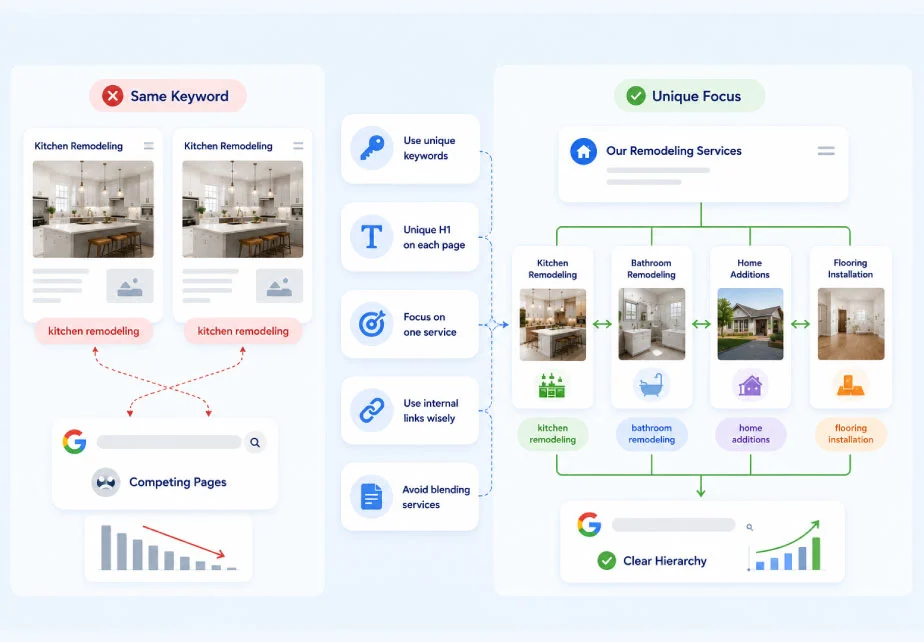
Keyword cannibalization happens when multiple pages compete for the same keyword. Remodeling companies are especially vulnerable.
How to prevent cannibalization
- Use unique keywords for each service
- Avoid repeating the same H1 across pages
- Keep content focused on one service
- Use internal linking to clarify hierarchy
- Avoid blending services on the same page
When each page has a clear purpose, rankings improve.
Conclusion: A Structured SEO Strategy Helps Every Remodeling Service Rank Independently
Remodeling companies in Myrtle Beach can dramatically improve organic visibility by:
- creating dedicated service pages
- organizing content with a clear hierarchy
- strengthening internal linking
- optimizing project galleries
- building location‑specific pages
- using schema to support AI and traditional search
- preventing keyword cannibalization
When executed correctly, this structure allows each remodeling service to rank independently — and ensures your website attracts high‑intent leads across the entire Grand Strand.
Call to Action:
If you want a complete remodeling SEO strategy tailored to your Myrtle Beach service area, schedule a strategy session with our team. We’ll audit your current setup, identify gaps, and build a plan that increases visibility, improves conversions, and drives consistent high‑intent remodeling leads.
FAQ
Do kitchen and bathroom remodeling pages need to be separate?
Yes. Dedicated pages match buyer intent and improve keyword relevance.
Which Myrtle Beach areas should remodeling companies target with location pages?
North Myrtle Beach, Surfside Beach, Conway, Murrells Inlet, and Carolina Forest.
How does AI search affect remodeling SEO in 2026?
AI Overviews rely heavily on structured Q&A, schema, and entity‑rich content.
How do I prevent service pages from competing with each other?
Use unique keywords, clear hierarchy, and focused content for each service.