

Table of Contents
If you run a pest control company in Spartanburg, you already know the rhythm: phones ring off the hook from April through October, and then things get quiet. Ants, mosquitoes, and stinging insects drive summer demand — but winter feels like a waiting game. The problem is that waiting costs you money.
Here is the truth most pest control owners miss: people do not stop searching for pest control services in the off-season. They just search for different things. And the companies that show up in Google Maps during those quieter months are the ones walking into spring with a full pipeline.
Here is exactly how to use Google Maps and local search to generate leads year-round — not just when temperatures climb.
Why Google Maps Is Your Most Powerful Off-Season Tool
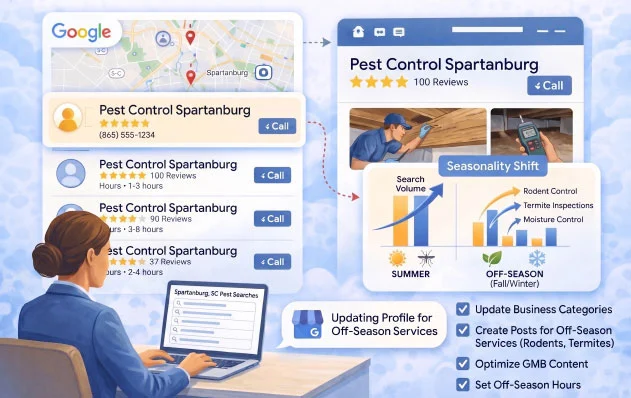
When someone searches pest control near me or termite inspection Spartanburg SC, Google does not return a list of websites. It returns a map pack — three local businesses with ratings, hours, and a call button. That map pack is prime real estate, and it is available to every company willing to optimize for it.
The difference between peak season and off-season is not that people stop searching. It is that the volume shifts toward different services. Rodent control, termite inspections, moisture control, and indoor pest prevention all see steady or increased searches in fall and winter. If your Google Business Profile is only set up for summer services, you are invisible when those searches happen.
Start With Your Google Business Profile
Your Google Business Profile (GBP) is the single most influential factor in whether your business appears in local map results. Most pest control companies set it up once and forget about it. That is a missed opportunity every week of the year.
During the off-season, go into your GBP and add winter-specific services. If you offer rodent exclusion, add it. Attic insulation? Add it. Moisture barrier treatments? Add it. Google uses your service list to match your profile to relevant searches — if the service is not listed, you will not show up for it.
Update your business description too. Include seasonal language that reflects what you are offering right now, not just a generic paragraph about your company. In January, homeowners are worried about mice getting in, not mosquitoes. Speak to that.
Consistent Reviews Win the Off-Season
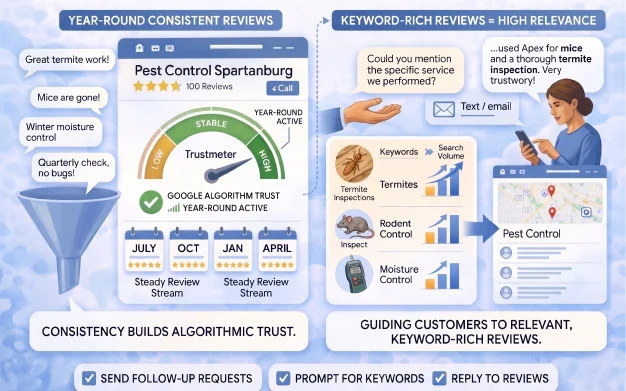
Reviews are the lifeblood of your Google Maps ranking. But here is what most businesses get wrong: they collect reviews in bursts during busy season and go dark the rest of the year. Google’s algorithm notices the pattern.
A steady stream of reviews — even one or two per week — signals to Google that your business is active and trustworthy year-round. During slower months, create a simple follow-up system. After every service call, send a text or email with a direct link to your Google review page. Make it effortless.
Pay attention to what your reviewers say. If customers mention mice, termites, or inspections in their reviews, those keyword-rich reviews improve your relevance for those searches. You cannot control what customers write, but you can prompt them by asking something specific: Could you mention the service we performed today?
Post Updates to Stay Visible
Most pest control companies do not use Google Posts — which means using them is an easy way to stand out. Google Posts appear directly on your Business Profile and can highlight seasonal offers, tips, or reminders.
In October, post about rodent-proofing before winter. In December, remind homeowners that termite swarms happen in spring — and now is the time for inspections. In February, post about signs of moisture damage that can attract pests. These posts cost nothing and keep your profile active in Google’s eyes.
Consistent posting also signals that you are an engaged business owner, which can influence how Google treats your listing in competitive searches.
Target Off-Season Services With Specific Keywords
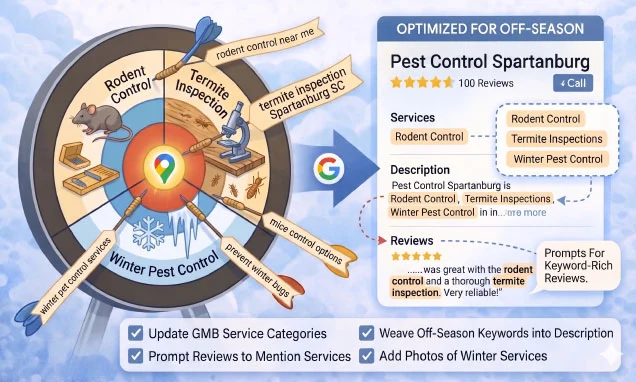
The biggest shift you can make for off-season lead generation is targeting services that are genuinely in demand during colder months. Searches like termite inspection Spartanburg SC, rodent control near me, and winter pest control all have real search volume — they are just different from the summer keywords you are used to.
Build your Google Maps presence around these off-season services explicitly. Add them to your service categories, weave them into your GBP description, and prompt reviews that mention them. The more consistently Google connects your profile to these searches, the more often you will appear when a homeowner types them in.
Do Not Neglect Your Website’s Local Foundation
Your Google Maps visibility does not exist in isolation. Google cross-references your GBP with your website, and inconsistencies hurt your rankings. Make sure your business name, address, and phone number are identical across both — down to abbreviations like St. versus Street.
If you want to rank for off-season services, those services should also have dedicated content on your website. A page about rodent control in Spartanburg, SC is not just helpful for potential customers — it reinforces to Google that your business actually provides that service.
The Year-Round Mindset
Pest control in Spartanburg SC will always have seasonal peaks. But the companies that treat off-season months as a growth opportunity — rather than a slowdown to survive — build something their competitors do not: consistent visibility.
Google Maps rewards businesses that stay active, collect fresh reviews, update their services, and engage with their local presence. None of this requires a big budget. It requires consistency. Do it through summer, fall, winter, and spring, and you will be the first result when a homeowner in Spartanburg wakes up in January and finds something they did not invite into their house.